Home › Resources › Group Travel › Planning a Group Luau
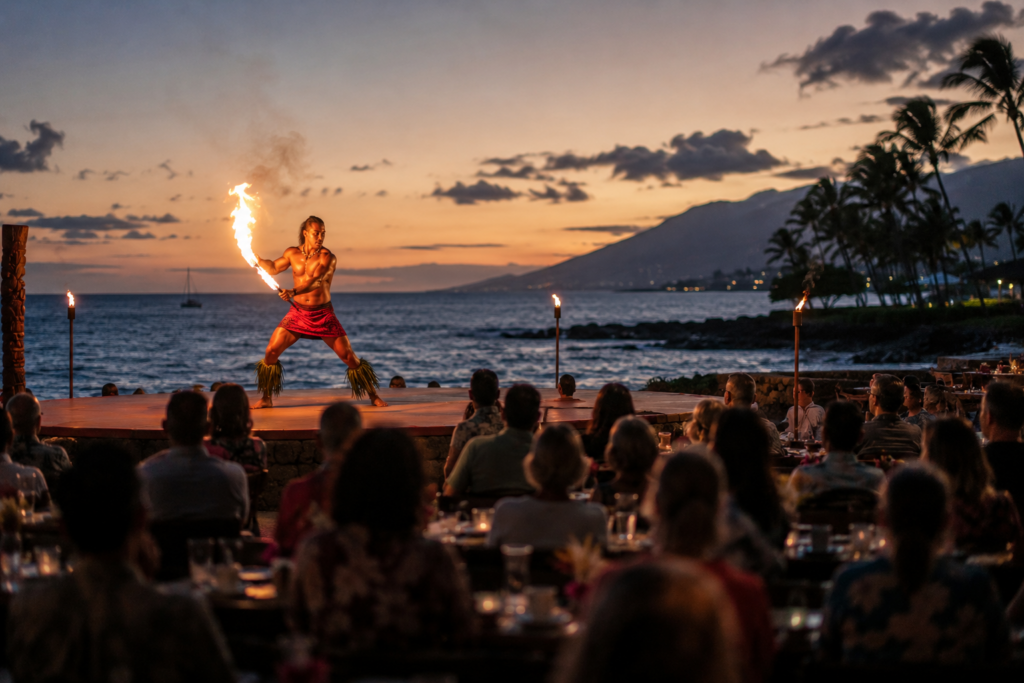
How to Plan a Group Luau in Hawaii
For two people a luau is a ticket; for a group it is a coordinated event — a buyout or a block of seats, sized, transported, and timed. Here is how to plan a luau that works for a whole group.
For any planner adding a luau to a Hawaii group program · 7 min read · Updated July 2026
Reviewed by Conway Kaka, Founder
10+ years coordinating Hawaiʻi group logistics
Updated August 7, 2026
Key Takeaways
A group luau is booked one of two ways, and the choice shapes everything else: a private buyout, where the group takes the whole venue and controls the night, or a block of reserved seats at a scheduled commercial luau, where the group joins a fixed show. A buyout gives control and privacy for a larger group and a price to match; a seat block is simpler and better value for a smaller group willing to share the room. Once the model is set, a group luau is a logistics problem — sizing the booking, getting everyone there for a fixed start time, and handling dietary needs and seating for the whole group at once. A luau is one kind of evening event; a DMC coordinates it as its own piece of the program.
A Luau Is Easy for Two and a Project for Two Hundred
Buying two luau tickets online takes a minute. Bringing a group of fifty, a hundred, or two hundred to a luau is a different task entirely, because now there is a headcount to seat together, a fixed start time everyone has to make, transport from the hotels to a venue that is often not close, and dietary needs across the whole group to sort before the night. A luau is one kind of evening event — for the full range of group dinners and evenings, see the guide to dining and evening events for a large group; this guide is about the luau specifically, because a luau has its own decision at the front that other dinners do not: whether to take the venue privately or join a scheduled show. Get that decision and the logistics behind it right, and a group luau becomes the highlight of the trip instead of the night the group got scattered across a parking lot.
A luau is one piece of a larger program — see how it all fits in the complete guide to planning group travel in Hawaii.
Buyout or a Block of Seats
The first decision is the model, and there are two. A private buyout means the group takes the whole luau — the venue, the show, the meal, the timing — for its own event; nobody else is there, the night can be tailored, and the group controls it end to end. A block of reserved seats means the group joins a commercial luau that runs on its own schedule, taking a section of tables at a set show on a set night; it is simpler and costs less per person, but the group shares the venue and takes the luau as it comes. Neither is better in the abstract — a buyout fits a larger group that wants privacy, control, and a branded or private evening and can support the cost; a seat block fits a smaller group, or one that would rather spend the budget elsewhere and is happy to share the room. The whole rest of the plan follows from which one you choose.
Operational Tip
Decide buyout-versus-seats early, because it drives availability. Private buyouts are limited and book far ahead, especially in peak season and for larger groups, and a seat block of any size also needs to be reserved before the date fills. Leaving the luau to the last week usually means taking whatever is left — the wrong venue, the wrong night, or scattered seating — so the model and the date are locked early, alongside the rest of the program.
Choosing and Sizing the Luau
Once you know the model, choosing and sizing the luau is about matching it to the group. Size sets much of it: a buyout needs a venue whose capacity fits the group with room for the format, while a seat block needs enough contiguous seating that the group is together rather than split across the room. Budget matters because the two models sit at different price points, and because a luau is usually one line in a larger program budget. And fit matters — the luau’s location relative to the hotels, its show and menu, and its date within the itinerary all have to work for the group. The table below compares the two models across the decisions that matter most, so the choice is made on the group’s real needs rather than a guess.
Private buyout vs. a block of seats
| Decision | Private buyout | Block of seats |
|---|---|---|
| Privacy | The group has the venue to itself | Shares the venue with other guests |
| Control | Timing, format, and details tailored | Joins a fixed show and schedule |
| Best for group size | Larger groups | Smaller groups |
| Per-person cost | Higher; scales with the buyout | Lower; better value to share |
| Lead time | Books far ahead; limited availability | Reserve the block before the date fills |
Transport, Timing, and Dietary
A luau lives or dies on three logistics after the booking. Transport is the first: luaus are often a real drive from the hotels and have a fixed start time, so the group moves together on coordinated vehicles timed to arrive before the show — part of the same on-island operations and access the rest of the program runs on, not a night everyone is left to find their own way. Timing is the second: a luau runs on its own clock, so the departure, the drive, and any pre-show time are sequenced backward from the start so the group is seated together and on time. Dietary is the third: a group carries allergies and preferences, and a luau buffet or plated service has to be told in advance so those needs are handled rather than discovered at the table. A group luau is booked once and coordinated as its own evening — and for a family reunion or a corporate retreat, it is very often the night the whole trip is built around, as covered in the family reunion and corporate retreat guides.
Group luau coordination checklist
- Decide the model early — private buyout or a block of reserved seats.
- Lock the venue and date before availability fills, especially for a buyout.
- Size the booking so the group is seated together, not split across the room.
- Match the luau’s location, show, and menu to the group and the itinerary.
- Coordinate transport so the group arrives together, before the fixed start time.
- Sequence the departure backward from the show time.
- Collect and confirm dietary needs with the venue in advance.
- Treat the luau as its own coordinated evening within the program.
How AGT Coordinates Group Luaus
These are not hypotheticals. Group luau and evening-event coordination sit inside AGT’s documented operations.
Related AGT Services & Programs
Hawaii Group Tour & Activity Coordination
Activity and evening coordination for group programs, luaus included.
Hawaii Group Program Coordination
The on-island coordination that fits the luau into the program.
Adding a Luau to Your Group Program?
Tell us your group size and your dates, and AGT will coordinate the luau — booking, transport, and timing.
Frequently Asked Questions
Should a group do a private luau buyout or a block of seats?
It depends on size and priorities. A private buyout gives a larger group the venue to itself with control over timing and format, at a higher cost; a block of reserved seats lets a smaller group join a scheduled luau for less, sharing the room. A buyout suits privacy and control; a seat block suits value and simplicity. The choice drives the rest of the plan.
How far ahead should we book a group luau?
Early — alongside the rest of the program, not in the final week. Private buyouts are limited and book far ahead, especially in peak season and for larger groups, and even a seat block needs to be reserved before the date fills. Booking late usually means taking the wrong venue, the wrong night, or scattered seating instead of the group’s first choice.
How do you get a whole group to a luau on time?
With coordinated transport timed to the show. Luaus are often a real drive from the hotels and start at a fixed time, so the group moves together on vehicles sequenced backward from the start time to arrive before the show, rather than everyone finding their own way and trickling in. It is part of the same on-island coordination the rest of the program uses.
How are dietary needs handled at a group luau?
In advance, with the venue. A group carries allergies and preferences, so those are collected before the night and confirmed with the luau — buffet or plated — so the service is ready for them. Handling dietary needs ahead of time is the difference between a smooth table and a scramble when the food comes out.
How is a group luau different from planning other group dinners?
A luau adds one decision other dinners do not have: whether to take the venue privately or join a scheduled show. It also has a fixed start time and is often far from the hotels, so transport and timing matter more than for a hotel banquet. It is one kind of evening event, planned as its own piece within the broader dining and evening plan.
Can a DMC coordinate the luau as part of the whole trip?
Yes — and a luau works best when it is coordinated as one piece of the whole program rather than booked in isolation. A DMC picks the model, locks the venue and date, sizes the booking, runs the transport and timing, and handles dietary needs, so the luau lands as the highlight of the trip instead of a logistics scramble.

ABOUT THE AUTHOR
Conway Kaka
Founder, Aloha Group Travel
10+ years coordinating Hawaiʻi group logistics across Oʻahu, Maui, Kauaʻi, Kona, and Hilo — airport transfers and meet-and-assist, Pearl Harbor and cruise programs, hotel coordination, and multi-island itineraries. He personally reviews AGT’s planning resources to reflect how programs actually run on the ground in Hawaiʻi.
Related Resources
How to Plan Dining and Evening Events for a Large Group
How to Plan On-Island Operations and Access
Planning a Group Luau in Hawaii?
Tell us your group size, your dates, and whether you want the venue to yourselves, and AGT will coordinate the luau — booking, transport, timing, and dietary.
Call Us +1 (808) 232-1229