Home › Resources › Multi-Island Programs › Planning a Multi-Island Transfer Day
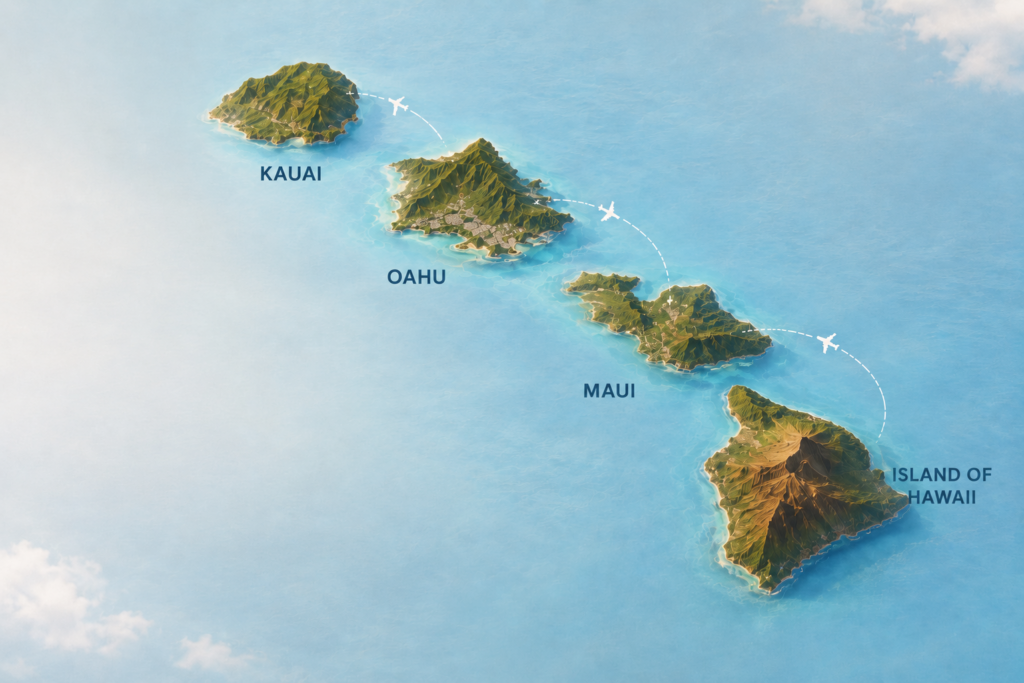
How to Plan a Multi-Island Transfer Day for a Hawaii Group
The day a group changes islands is the highest-risk day of a multi-island program — two airports, a checkout, a check-in, and everyone’s luggage, all on one clock. Here is how to plan it so the move lands cleanly.
For DMC, tour-operator, and multi-island group planners · 8 min read · Updated July 2026
Reviewed by Conway Kaka, Founder
10+ years coordinating Hawaiʻi group logistics
Updated August 7, 2026
Key Takeaways
A multi-island transfer day is the single most failure-prone day of a Hawaii group program: the group checks out of one hotel, transfers to an airport, flies to another island, and transfers to a new hotel — often before that hotel’s rooms are ready. Plan it backward from the inter-island flight, sequence checkout and the departure transfer to make the flight with margin, move luggage as a coordinated block, and build a landing-side plan for the gap between arrival and check-in. A DMC coordinates the transfers on both islands, the luggage, and the timing so a group changes islands without losing a day.
The Riskiest Day on a Multi-Island Program
On a multi-island program, most days are spent on one island with a hotel that holds your rooms and a schedule you control. The transfer day is different. It is the one day the whole group is in motion between two islands, dependent on an inter-island flight that leaves on time whether the group is ready or not, and landing on an island where the next hotel may not have rooms until mid-afternoon. Everything that is normally forgiving — a slow checkout, a late bag, a delayed vehicle — becomes a hard timing dependency, because a missed inter-island flight cascades into a missed afternoon, a missed activity, and a group stuck at an airport. It is the day a multi-island program is most likely to come apart, and it is entirely a logistics problem — which means it can be planned.
Inter-island flights have to be locked early — see when in the Hawaii group travel planning timeline.
What a Multi-Island Transfer Day Actually Involves
A transfer day is four movements chained together, each with its own failure point. First, checkout: the group has to be out of its rooms, bags gathered, and loaded, on a hotel’s checkout clock. Second, the departure-side airport transfer: getting the group to the origin airport with enough margin for inter-island bag-check and security, which for a group is never quick. Third, the inter-island flight itself: a fixed departure the group is now building its whole day around. Fourth, the arrival-side transfer: meeting the group at the destination airport and moving it to the next hotel — into the gap before check-in. Each of these is a piece AGT plans on both islands, and the chain is only as strong as its tightest link. This is why a transfer day is planned as its own operation, not treated as a travel day that happens between the real program.
Operational Tip
Plan the transfer day backward from the inter-island flight’s departure, exactly as you would a departure day around a flight home — because that is what the first half of a transfer day is. The difference is that a second half begins the moment the group lands, so the arrival side needs the same arrival planning as day one of the program.
Sequencing the Day Around the Inter-Island Flight
The inter-island flight is the pin the whole day hangs on, and everything sequences around it. Working backward from departure, you subtract the inter-island check-in and security window, the airport transfer drive, and the checkout-and-load time — and what remains sets how early the group’s morning starts. Working forward from arrival, you account for the destination transfer and the near-certain gap before the next hotel’s rooms are ready, which has to be filled with something useful rather than a group sitting on its bags in a lobby. The table below shows the transfer-day chain and where each link tends to break. A group that gets the morning half right and ignores the landing half still loses the afternoon; both halves have to be planned.
The transfer-day chain and where it breaks
| Transfer-day stage | The task | Where it breaks |
|---|---|---|
| Checkout & load | Group out of rooms, bags gathered and loaded | Slow checkout; scattered bags; late start |
| Departure transfer | To the origin airport with margin | Underestimated group check-in / security time |
| Inter-island flight | Fixed departure; the day’s anchor | Missing the window; no buffer for delay |
| Arrival transfer | Meet the group; move to the next hotel | Curb access; luggage transfer at destination |
| Check-in gap | Fill the time before rooms are ready | Group stuck in the lobby with luggage |
On-the-Ground Logistics: Luggage, Gaps, and Contingency
Three things separate a smooth island change from a lost day. Luggage is the first: a group’s bags have to be gathered, counted, and moved as a coordinated block through two airports, and inter-island baggage rules and a group’s sheer volume make this a planned operation, not a scramble. The check-in gap is the second: because inter-island flights land a group mid-day and hotel rooms often are not ready until afternoon, the plan needs a productive place for the group to be — bag storage plus an activity, a meal, or on-island touring — so the gap becomes part of the program instead of dead time on the bags. Contingency is the third: an inter-island flight can be delayed or cancelled, so the plan needs a fallback for a shifted flight and a reachable ground contact on both islands. This is coordination that spans two islands at once, and it is exactly what a ground operator holds together. On the ground itself, the group is moving through the same access and staging conditions covered in on-island operations and access.
Multi-island transfer day checklist
- Plan the whole day backward from the inter-island flight departure.
- Sequence checkout and the departure transfer with a real airport-check-in buffer.
- Gather, count, and move luggage as one coordinated block across both airports.
- Confirm curb access and staging at both the origin and destination airports.
- Plan the arrival-side transfer to the next hotel.
- Fill the check-in gap with bag storage plus an activity, meal, or touring.
- Build a contingency for a delayed or cancelled inter-island flight.
- Confirm a reachable ground contact on both islands.
How AGT Handles Island Changes in Practice
These are not hypotheticals. Inter-island moves sit inside AGT’s documented multi-island group operations.
Related AGT Services & Programs
Planning a Multi-Island Group Program?
Tell us your islands and dates, and AGT will coordinate the transfer days on both sides.
Frequently Asked Questions
What is a multi-island transfer day?
It is the day a group changes islands — checking out of one hotel, transferring to an airport, flying inter-island, and transferring to a new hotel on the next island. It is the highest-risk day of a multi-island program because the whole group is in motion around a fixed inter-island flight, often landing before the next hotel’s rooms are ready.
Why is the transfer day the riskiest day of a multi-island program?
Because a fixed inter-island flight turns every earlier step — checkout, luggage, the airport transfer — into a hard timing dependency, and a miss cascades into a lost afternoon. Unlike a single-island day, there is no hotel holding the group’s place and no schedule the planner fully controls.
How do you handle the gap before hotel check-in on the arrival island?
You plan for it. Inter-island flights usually land a group mid-day, before rooms are ready, so the plan uses bag storage plus a productive use of the time — an activity, a meal, or on-island touring — so the group is not stuck in a lobby on its luggage. The gap becomes part of the program.
How is group luggage handled across two islands?
As a coordinated block. The group’s bags are gathered, counted, and moved together through both airports, planned around inter-island baggage rules and the group’s volume. For a group, luggage is a planned operation on the transfer day, not something handled individually at the counter.
What happens if the inter-island flight is delayed or cancelled?
The plan carries a contingency: a fallback for a shifted flight and a reachable ground contact on both islands who can re-stage the transfers and adjust the landing-side plan. The goal is that a flight disruption costs the group time, not the rest of the day.
Can a DMC coordinate the transfer day on both islands?
Yes. A DMC plans the day backward from the inter-island flight, coordinates the departure and arrival transfers on both islands, moves the luggage as a block, fills the check-in gap, and holds a contingency — so a group changes islands without losing a day.

ABOUT THE AUTHOR
Conway Kaka
Founder, Aloha Group Travel
10+ years coordinating Hawaiʻi group logistics across Oʻahu, Maui, Kauaʻi, Kona, and Hilo — airport transfers and meet-and-assist, Pearl Harbor and cruise programs, hotel coordination, and multi-island itineraries. He personally reviews AGT’s planning resources to reflect how programs actually run on the ground in Hawaiʻi.
Related Resources
How to Plan Group Arrival and Meet-and-Assist in Hawaii
How to Plan Group Departures and Manifest Reconciliation
How to Plan a Group Hotel Room Block and Rooming List
Planning a Multi-Island Program in Hawaii?
Tell us your islands, your dates, and your group size, and AGT will handle the ground — transfer days, transfers on every island, and the timing that holds it together.
Call Us +1 (808) 232-1229