Home › Resources › Cruise Groups › Planning Cruise Shore Excursions for Groups
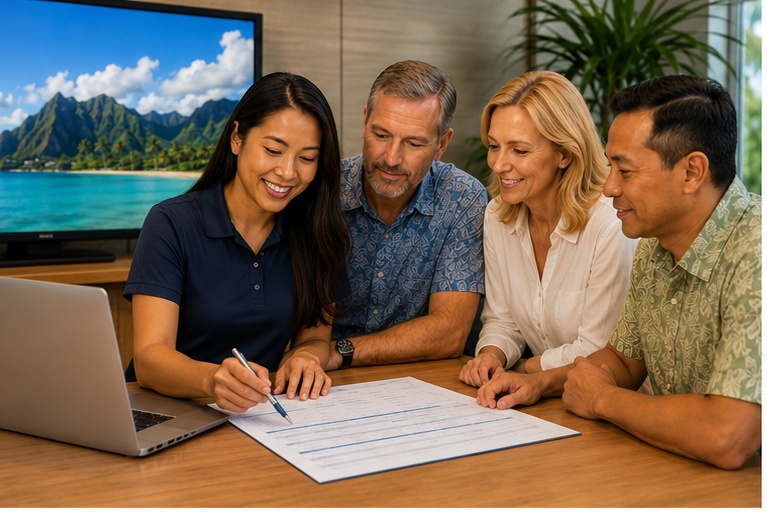
How to Plan Cruise Shore Excursions for a Group in Hawaii
Every shore excursion in Hawaii runs against one hard deadline: all-aboard. Here is how to plan port days so a group gets ashore, sees what it came for, and is back before the gangway lifts.
For cruise, travel-trade, and group planners · 8 min read · Updated July 2026
Reviewed by Conway Kaka, Founder
10+ years coordinating Hawaiʻi group logistics
Updated August 7, 2026
Key Takeaways
- Hawaii cruise shore excursions live or die on timing. The all-aboard time is a hard deadline the ship will not hold, tender ports and controlled pier access eat into the usable window, and independent excursions do not carry the cruise line’s ‘back on time’ guarantee. Plan each port day backward from all-aboard, build in a real buffer, stage group transportation at the pier in advance, and know which ports are docked versus tendered. A local ground operator coordinates pier logistics, timing, and transportation so a group makes the most of the day and none of it against the ship’s clock.
The Deadline That Changes Everything
A shore excursion is just a day tour with one difference that changes everything about how you plan it: the ship leaves without you. On land, a late motorcoach means a rearranged afternoon. On a port day, missing the all-aboard time means missing the ship — and catching up to it at the next island at your own expense. That single fact reorders every priority. Distance from the pier, the reliability of the operator, whether the port is docked or tendered, how fast a large group clears the terminal — details that would be minor on a land program become the whole game. For a group the margin is thinner still, because a hundred people move slower than two, and the clock does not care.
Planning a Port Day Backward From All-Aboard
The only sound way to build a port day is in reverse. You start from the all-aboard time — not the departure time, the all-aboard time, which is typically thirty to sixty minutes earlier — and work backward. Subtract the time to get the group from the excursion back to the pier and through the terminal; subtract a real buffer for traffic, a slow group, or an activity that runs long; and what remains is the usable time ashore. It is almost always less than planners expect. In Hawaii the ports compound this: the islands are spread out, the best-known sights are often a real drive from the pier, and a group that wants to combine two experiences in one port day can find the timing simply does not close. The discipline is to design the day to fit the window, not to design the day you want and hope the window stretches.
Operational Tip
Never book a group onto an independent shore excursion whose return timing you have not verified against the all-aboard time — with a buffer. Cruise-line excursions carry a guarantee that the ship waits or the line gets you to the next port; independent tours do not. If you use independent operators for the flexibility and value, the timing buffer is what replaces that guarantee.
The All-Aboard Deadline and Why Buffers Are Not Optional
All-aboard is exactly what it sounds like: the time every passenger must be back on the ship, ahead of the actual departure, so the crew can complete the manifest count and clear for sailing. It is not negotiable and it is not a suggestion; ships sail on schedule because the next port, the pilots, and the berth reservations all depend on it. For a group, the buffer between ‘excursion ends’ and ‘all-aboard’ is the most important number on the whole day, and it should be generous — a large group loading a motorcoach, hitting Hawaii traffic, and clearing a busy terminal can lose thirty minutes without anything going wrong. The table below shows how the same port day changes depending on whether the port is docked or tendered, because a tender port can quietly cost a group an hour it did not budget.
How port type changes a group’s day
| Port type | What it means | Time impact for a group |
|---|---|---|
| Docked (alongside) | Ship ties up at the pier; walk on and off | Fastest; group moves directly to staged transport |
| Tender port | Ship anchors offshore; passengers ferried by small boats | Adds significant time each way; tenders queue — build a large buffer |
| Controlled terminal | Pier access is secured; motorcoaches stage in assigned areas | Group must clear the terminal on foot; coordinate staging in advance |
| Independent excursion | Operator not affiliated with the cruise line | No return guarantee; the buffer is your safety margin |
| Cruise-line excursion | Sold and timed by the line | Ship waits or line covers catch-up; less flexible, higher cost |
Pier Logistics: Getting a Group Ashore and Back
The pier is where group cruise days are won or lost. Cruise terminals are controlled environments: motorcoaches cannot idle at the gangway, staging areas are assigned, and a group of sixty stepping off the ship has to be marshaled, matched to its transport, and moved out before the day can start — then reversed, under time pressure, at the end. In Hawaii this plays out across several piers with different layouts: Honolulu on Oahu, Kahului on Maui, Hilo and Kailua-Kona on the Big Island, and Nawiliwili on Kauai, each with its own access rules and its own drive times to the sights. A ground operator who works these piers stages vehicles before the ship is cleared, keeps a dispatch contact reachable through the day, and knows how long the return leg actually takes at that port — the difference between a relaxed reboarding and a sprint to the gangway.
Cruise group port-day checklist
- Confirm the all-aboard time for each port — not just the departure time.
- Build the day backward from all-aboard, with a real return buffer.
- Identify which ports are docked and which are tendered; budget tender time.
- Stage group transportation at the pier in advance; confirm the assigned staging area.
- Verify independent operators’ return timing against all-aboard, with buffer.
- Keep a reachable dispatch or ground contact for the whole port day.
- Brief the group on reboarding time and where transport will meet them.
- Plan for terminal-clearance time on both ends for a large group.
How AGT Handles Cruise Groups in Practice
These are not hypotheticals. Cruise port days sit inside AGT’s documented shore-excursion and pier-transfer operations across the Hawaiian islands.
Related AGT Services & Programs
Planning Port Days for a Cruise Group?
Tell us your ship, your ports, and your group size, and AGT will build shore excursions that fit the all-aboard clock.
Frequently Asked Questions
What is an all-aboard time?
All-aboard is the time every passenger must be back on the ship, set ahead of the actual departure — usually thirty to sixty minutes — so the crew can complete the passenger count and clear for sailing. It is a hard deadline; the ship sails on schedule whether or not a late excursion has returned.
Are independent shore excursions risky for groups?
They are lower-risk when timed correctly and often higher-value than cruise-line tours, but they do not carry the line’s guarantee to wait or to get you to the next port. For a group the safeguard is a verified return time with a real buffer against all-aboard. Used that way, independent operators give you flexibility and better group pricing.
What is a tender port, and why does it matter for a group?
At a tender port the ship anchors offshore and ferries passengers ashore in small boats rather than tying up at a pier. Tenders queue and prioritize, so for a large group the time to get everyone ashore and back can add up to an hour or more each day — time that has to be built into the plan. In Hawaii, Kailua-Kona is commonly a tender port.
How much time does a group actually get in port?
Less than the posted port hours suggest. From the arrival time you subtract terminal clearance, transport to and from the sight, and a return buffer against all-aboard — and what is left is the usable window. Building the day backward from all-aboard is the only way to see that number honestly before you commit the group.
Which Hawaii cruise ports are docked versus tendered?
It varies by ship and berth assignment, so it should always be confirmed for your specific sailing. As a general pattern, Honolulu, Kahului, Hilo, and Nawiliwili are typically alongside berths, while Kailua-Kona is frequently a tender port. A ground operator confirms the current arrangement for your dates.
Can a DMC coordinate shore excursions for a whole cruise group?
Yes. A local ground operator plans each port day around its all-aboard time, stages transportation at the pier, keeps a dispatch contact reachable through the day, and sequences the excursions so a large group gets ashore and back with margin to spare — across every island the ship visits.

ABOUT THE AUTHOR
Conway Kaka
Founder, Aloha Group Travel
10+ years coordinating Hawaiʻi group logistics across Oʻahu, Maui, Kauaʻi, Kona, and Hilo — airport transfers and meet-and-assist, Pearl Harbor and cruise programs, hotel coordination, and multi-island itineraries. He personally reviews AGT’s planning resources to reflect how programs actually run on the ground in Hawaiʻi.
Related Resources
Free cruise planning tools
Reusable, operator-built resources for planning a group’s cruise port days in Hawaii — drawn from real four-island operations. Free to download.
Cruise Shore Excursion Port-Day Checklist
Run a group’s port day backward from all-aboard — docked or tender — without leaving anyone on the pier.
For professional group planners
Per-Port Cruise Excursion Planning Worksheet
Plan every port’s excursion and prove it fits the real shore time — on one fillable sheet.
For professional group planners
Cruise Port-Day Time-Budget Calculator
Enter a port’s window and tender transit; get the real shore time and whether the excursion fits — in seconds.
For professional group planners
Cruise Shore Excursion Planning Guide
The operating logic behind planning a group’s shore excursions in Hawaii — docked or tender, inside the real shore time.
For professional group planners
Cruise Group Planning Kit
One control system for a whole cruise group program — port-by-port shore-time budgets and per-port excursion control.
For professional group planners
Planning a Hawaii Cruise Group Program?
Tell us your ship, your ports, and your dates, and AGT will handle the ground — shore excursions, pier transfers, and transportation timed to the ship.
Call Us +1 (808) 232-1229